




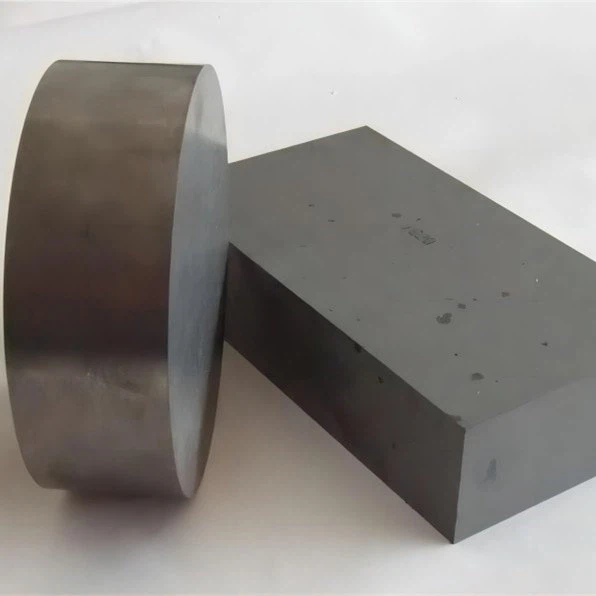


Nickel Hard Cast Iron
Nickel hard white cast iron contains nickel and chromium alloy elements, which is known as "Ni-Hard" in the world, and China has included it in the national standard.

- Product Introduction
Nickel Hard Cast Iron

Nickel hard white cast iron contains nickel and chromium alloy elements, which is known as "Ni-Hard" in the world, and China has included it in the national standard. The addition of nickel can improve the quenchability and obtain a martensite-based metal matrix with more residual austenite, which can improve toughness. The addition of chromium is used to prevent the precipitation of graphite and produce a carbide with higher hardness. Nickel hard cast iron is added 3.0% to 5.0% nickel and 1.5% to 3.5% chromium based on ordinary white cast iron to obtain a very hard and wear-resistant martensitic matrix + M3C carbide structure. The infinite solid solution of nickel and iron can effectively improve quenchability, promote the formation of a martensite-besite matrix, while nickel stabilizes austenite. Too high nickel content can cause a large amount of residual austenite. The addition of chromium can prevent graphitization, promote the formation of carbide, and improve the hardness of M3C type carbide from HV 900 to 1000 to HV 1100 to 1200. The wear resistance of nickel hard cast iron is better than that of ordinary white-mouth cast iron and is widely used in mining, electric power, cement, ceramic, and casting industries.
Nickel hard cast iron production
(1) Casting process Nickel hard cast iron can be made using sand or metal type. The linear shrinkage rate is 1.6% to 2.0%, usually 1.8%. The casting process is the same as that of general white cast iron, usually using the outlet and creating a direct pouring channel into the casting to form good sequential solidification conditions.
(2) Molten nickel hard cast iron is best produced using an electric furnace (induction electric furnace or electric arc furnace) for smelting to control the chemical composition and furnace temperature. Ni-Hard 1 and Ni-Hard 2 can be used in some countries, but Ni-Hard 4 is not easy to smelt in a furnace to avoid the loss of alloy elements, especially chromium. Chromium easily forms carbide, making accurate control of carbon content difficult. The nickel and chromium content should be determined by considering the casting's wall thickness. To prevent graphite in the structure, there should be an appropriate relationship between C, Si, Cr, and the casting's wall thickness.
(3) The melting point of pouring nickel hard cast iron is higher than that of gray cast iron, and its fluidity is worse than that of gray cast iron. Therefore, the pouring temperature should be higher than that of gray cast iron. Generally, the pouring temperature of nickel hard cast iron is 1400℃, and for large, thick castings, the pouring temperature can be reduced appropriately, but it should not be lower than 1350℃.
Hot Tags: nickel hard cast iron, China nickel hard cast iron manufacturers, suppliers, High Manganese Steel Castings, , High Manganese Steel Castings, High Manganese Steel Castings,


