




What is the composition of Nickel Hard Cast Iron?
 Jun 26, 2025|
 Nickel hard cast iron is a remarkable material that has found extensive applications across various industries due to its unique combination of properties. As a supplier of nickel hard cast iron, I am well - versed in its composition and the benefits it offers. In this blog, I will delve into the detailed composition of nickel hard cast iron, explore its characteristics, and highlight its significance in different industrial scenarios.
Composition of Nickel Hard Cast Iron
Nickel hard cast iron is a complex alloy, and its composition is carefully engineered to achieve specific mechanical and physical properties. The primary elements in nickel hard cast iron include iron (Fe), carbon (C), nickel (Ni), chromium (Cr), and sometimes other alloying elements.
Iron (Fe)
Iron forms the base of nickel hard cast iron. It provides the fundamental structure and most of the mass of the alloy. Iron has good ductility and can dissolve other elements to form a solid - solution matrix. In nickel hard cast iron, the iron matrix serves as a framework that holds the other alloying elements and carbide phases, which contribute to the overall mechanical properties of the material.
Carbon (C)
Carbon is a crucial element in nickel hard cast iron. It is present in the form of carbides, which are responsible for the high hardness and wear resistance of the alloy. The carbon content in nickel hard cast iron typically ranges from 2% to 3%. These carbides, such as cementite (Fe₃C), are dispersed throughout the iron matrix, acting as hard particles that resist abrasion and deformation. The presence of carbon also affects the solidification process of the cast iron, influencing the formation of different microstructures.
Nickel (Ni)
Nickel is one of the key alloying elements in nickel hard cast iron. It is added in amounts ranging from 3% to 6%. Nickel has several important functions in the alloy. Firstly, it enhances the hardenability of the cast iron, allowing it to achieve a more uniform and fine - grained microstructure during heat treatment. This results in improved toughness and resistance to cracking. Secondly, nickel helps to stabilize the austenite phase at room temperature, which can contribute to better wear resistance under certain conditions. Additionally, nickel can improve the corrosion resistance of the cast iron, making it suitable for applications in corrosive environments.
Chromium (Cr)
Chromium is another significant alloying element, with a typical content of 1% to 3%. Chromium forms hard and stable carbides, such as chromium carbides (Cr₃C₂), which are even harder than cementite. These chromium carbides further enhance the wear resistance of the nickel hard cast iron. Chromium also improves the oxidation resistance of the alloy, protecting it from high - temperature oxidation and scaling. It can also refine the grain structure of the cast iron, leading to better mechanical properties.
Other Alloying Elements
In addition to the main elements mentioned above, other alloying elements may be added to nickel hard cast iron to further tailor its properties. For example, molybdenum (Mo) can be added in small amounts (less than 1%) to increase the strength and toughness of the alloy. Copper (Cu) may also be added to improve the corrosion resistance and machinability of the cast iron.
Microstructure of Nickel Hard Cast Iron
The microstructure of nickel hard cast iron is a complex combination of different phases. The iron matrix can be either ferrite, pearlite, or austenite, depending on the composition and heat treatment of the alloy. The carbides, including cementite and chromium carbides, are dispersed throughout the matrix. This dispersion of hard carbides in a relatively tough matrix gives nickel hard cast iron its excellent wear - resistant properties.
Properties and Applications
Wear Resistance
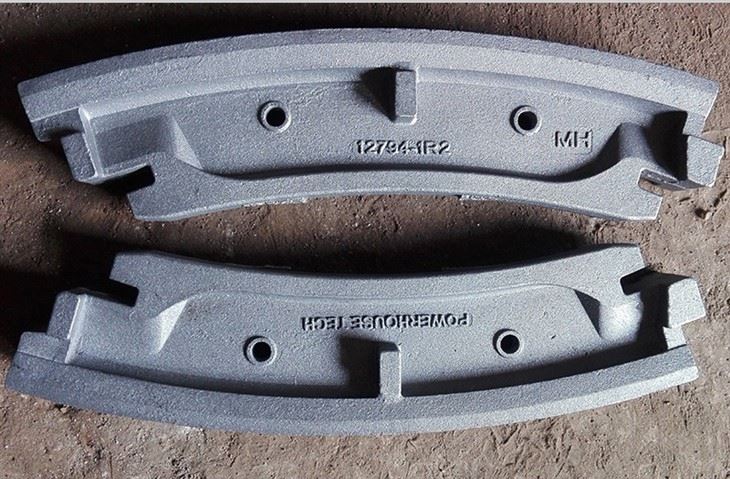
One of the most significant properties of nickel hard cast iron is its high wear resistance. This makes it an ideal material for applications where components are subjected to severe abrasion, such as in mining, cement production, and material handling industries. For example, Ball Grinding Cast Iron Parts made from nickel hard cast iron can withstand the constant impact and abrasion during the grinding process, resulting in longer service life and reduced maintenance costs.
Toughness
Despite its high hardness, nickel hard cast iron also has good toughness due to the presence of nickel and the carefully engineered microstructure. This allows it to resist cracking and chipping under impact loading. In applications such as crushing and milling, where components are subjected to high - energy impacts, the toughness of nickel hard cast iron ensures reliable performance.
Corrosion Resistance
The addition of nickel and other alloying elements improves the corrosion resistance of nickel hard cast iron. It can be used in applications where the components are exposed to mild corrosive environments, such as in some chemical processing plants. However, for more severe corrosive conditions, additional surface treatments or coatings may be required.
Applications
Nickel hard cast iron is widely used in various industries. In the mining industry, it is used for making crusher liners, mill liners, and wear plates. These components are constantly in contact with abrasive ores and rocks, and the high wear resistance of nickel hard cast iron ensures long - term performance. In the cement industry, Grey Cast Iron Parts made from nickel hard cast iron are used in crushers, ball mills, and conveyors. In the automotive industry, it can be used for manufacturing engine components that require high wear resistance and strength. In the foundry industry, Precision Casting Parts can be produced using nickel hard cast iron to meet the strict dimensional and performance requirements.
Advantages of Choosing Our Nickel Hard Cast Iron
As a supplier of nickel hard cast iron, we offer several advantages to our customers. Our production process is highly controlled, ensuring consistent quality and composition of the cast iron. We use advanced melting and casting techniques to achieve a uniform microstructure and optimal distribution of alloying elements. Our team of experts can provide technical support and guidance to help customers select the most suitable grade of nickel hard cast iron for their specific applications.
We also offer customized solutions. Whether you need a specific shape, size, or performance requirement, we can work with you to develop the right product. Our quality control system ensures that every piece of nickel hard cast iron we produce meets the highest standards.
Contact Us for Purchase and Negotiation
If you are interested in our nickel hard cast iron products, we invite you to contact us for further discussions. We are eager to understand your specific needs and provide you with the best solutions. Whether you are looking for standard products or custom - made components, we have the expertise and resources to meet your requirements. Please reach out to us to start the negotiation process and take advantage of the high - quality nickel hard cast iron that we offer.

References
- ASM Handbook, Volume 1: Properties and Selection: Irons, Steels, and High - Performance Alloys. ASM International.
- "Cast Iron Technology" by J. Campbell.
- Various industry research papers on the properties and applications of nickel hard cast iron.